Alpenglow
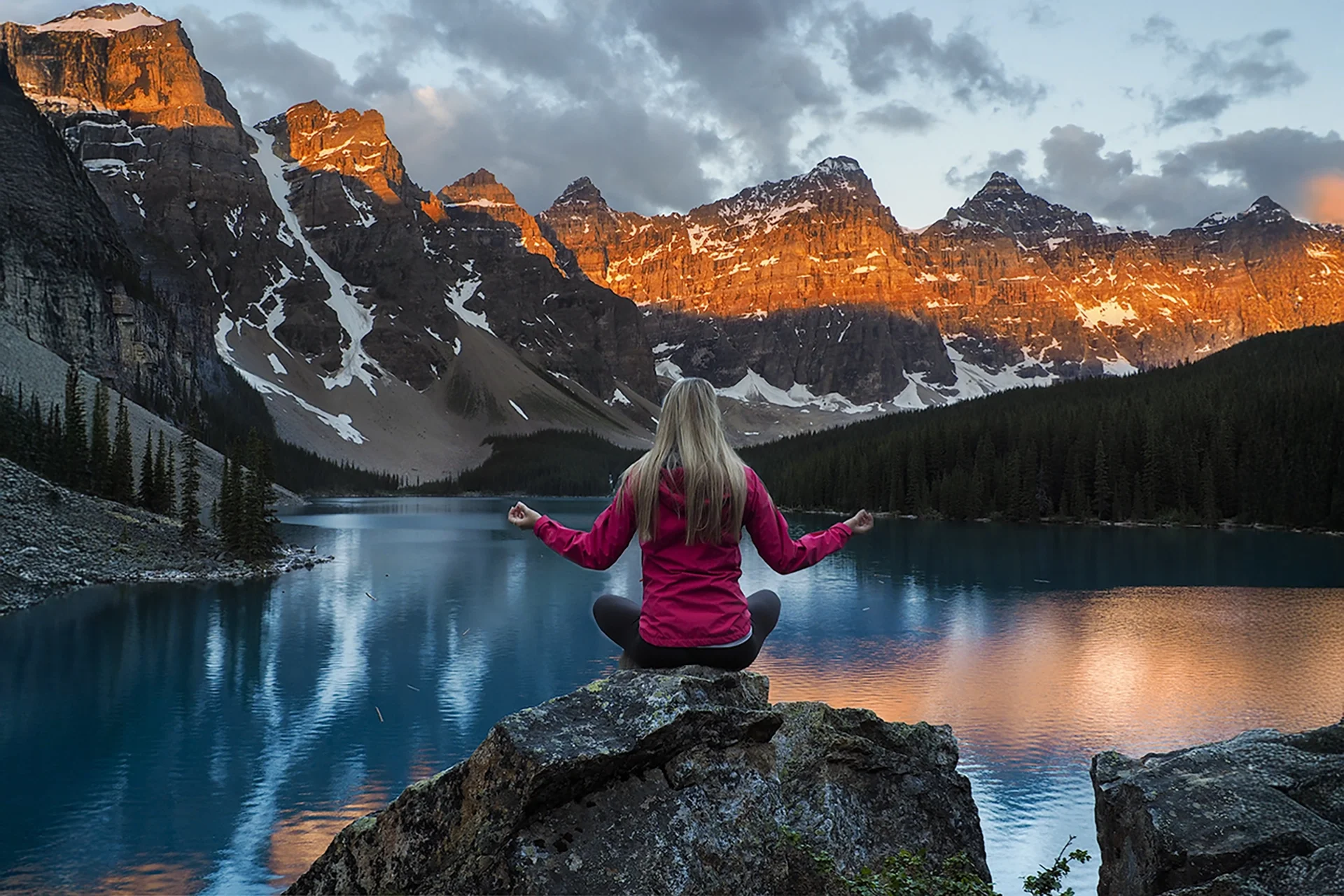
The pink or red glow on mountains opposite the rising/setting sun, caused by atmospheric scattering. Best seen on clear horizons—pair with Moraine Lake Sunrise Tour for peak color.


The pink or red glow on mountains opposite the rising/setting sun, caused by atmospheric scattering. Best seen on clear horizons—pair with Moraine Lake Sunrise Tour for peak color.
Sun is 18° below the horizon; the sky is at its darkest stage of dawn with minimal ambient light—useful for Milky Way set-ups.
The wide rosy band opposite the rising sun—often overlapping with the Belt of Venus; Earth’s shadow sits beneath it.
A rosy band of light above the horizon opposite the sun at dawn/dusk, with Earth’s shadow beneath it—often visible over the Valley of the Ten Peaks.
Cool-toned period before sunrise (and after sunset) when indirect sunlight gives the sky a blue cast. Great for reflection shots—see Experience Moraine Lake.
Enhanced haze/glow when looking toward the antisolar point; can deepen twilight color bands.
Sun is 6° below the horizon; usable natural light for most activities. Ideal for portraits before sunrise at Moraine Lake.
Sunbeams that appear to radiate from the sun due to light scattering between clouds and terrain.
The general brightening of the sky that begins morning twilight before sunrise.
The visible appearance of daylight following dawn; often used interchangeably with sunrise.
The dark bluish band above the horizon opposite the sun during twilight, caused by Earth blocking direct sunlight.
Around March 20 and September 22; day and night are nearly equal length—sunrise azimuth shifts are most noticeable around these dates.
The first visible illumination touching the landscape before the sun’s disk appears—watch peaks glow first.
Period just after sunrise when light is soft, warm, and low-angled—ideal for landscape texture. Book the Sunrise Tour or Dual Lakes Sunrise for maximum effect.
Astronomical measure of time/angle since the sun last crossed the local meridian; relates to sun position at dawn.
Diffuse brightening near the horizon prior to sunrise; influenced by aerosols, humidity, and topography.
Sunrise time based on the true position of the sun and local conditions (terrain, refraction).
Sun is 12° below the horizon; horizon line becomes faintly visible over water or snow—good for silhouettes at Lake Louise and Moraine Lake.
Scattering of shorter wavelengths by air molecules, making twilight skies appear red/orange near the horizon.
Bending of sunlight through the atmosphere that makes the sun appear earlier at sunrise and later at sunset.
Moment the upper edge of the sun first appears above the horizon—prime time for color and reflections. See the Moraine Lake Sunrise Tour.
Vertical shaft of light extending above the sun near sunrise/sunset, formed by ice crystals reflecting sunlight.
The moving line dividing day and night across Earth; near dawn it advances toward the observer.
The period of diffuse light before sunrise and after sunset: astronomical, nautical, and civil.
Rainfall that evaporates before reaching the ground; can catch dawn light for dramatic shafts and veils.
Around December 21 in the Northern Hemisphere; latest sunrise times occur near this date at many latitudes.
Lens opening (f-number) controlling light and depth of field.
Camera system that automatically adjusts focus on a subject.
Camera automatically sets ISO to maintain exposure within chosen limits.
Rays that appear to converge at the antisolar point; often a compositional element at dawn.
Capturing multiple exposures (e.g., −1/0/+1 EV) to blend or choose the best result.
Assigning AF activation to a rear button for faster, independent focusing.
Shutter remains open while the release is pressed—used for long exposures.
Color fringing from lens dispersion; often corrected in-camera or in post.
Arrangement of elements within the frame to guide the viewer’s eye.
Sensor-size multiplier affecting field of view compared to 35mm full-frame.
Zone of acceptable sharpness in front of and behind the focus plane.
The range between the darkest and brightest reproducible tones.
Softening caused when stopping down too far, as light bends around the aperture blades.
Combination of aperture, shutter speed, and ISO determining image brightness.
Intentional bias in metered exposure to make the image brighter or darker.
A scale that combines shutter speed and aperture to represent exposure levels numerically.
Optical distance determining field of view and magnification.
Edge-highlighting aid for manual focus on mirrorless/EVF cameras.
Neutral density, graduated ND, and circular polarizer filters used to control light and reflections.
Filter with a gradient to balance bright skies and darker landscapes.
Random variation in brightness/color; at high ISO it becomes visible as noise.
Graph showing tonal distribution from shadows (left) to highlights (right).
Flash technique allowing shutter speeds faster than the camera’s sync speed.
Focus distance maximizing depth of field from half that distance to infinity.
Using slow shutter speeds to blur motion (water/clouds) or capture low light.
Barrel/pincushion perspective bending; correctable in-camera or post.
In-camera or software process to reduce noise, potentially at the expense of detail.
Neutral density filter that uniformly reduces light to allow longer exposures.
Unprocessed sensor data file giving maximum latitude for editing.
Composition guideline dividing the frame into thirds horizontally/vertically.
Exposure time that controls motion blur and light intake.
A doubling/halving of light; used to describe exposure changes.
Camera or lens tech that counteracts shake for sharper images (In-Body IS, Vibration Reduction, Image Stabilization).
Exposure metering based on a small, central (or selected) area of the frame.
Three-legged support to keep the camera steady for sharp or long exposures.
Lens movement to control perspective or plane of focus; also used creatively.
Sequence of images captured at intervals to create accelerated-motion video.
Darkening toward the corners of an image, optical or added for effect.
Optical or electronic window for composing and focusing the image.
Color temperature setting to keep whites neutral under different lighting.
Short focal length lens providing a wide field of view.